Professional-Cloud-Architect Tests, Professional-Cloud-Architect Fragen Beantworten
Wiki Article
Außerdem sind jetzt einige Teile dieser Pass4Test Professional-Cloud-Architect Prüfungsfragen kostenlos erhältlich: https://drive.google.com/open?id=12eyW-5I356xLiT2VQ9SdlgSK1mab_yw6
Die Fragenkataloge zur Google Professional-Cloud-Architect Zertifizierungsprüfung aus Pass4Test ist eine Sammlung der Erfahrungen der zertifizierten IT-Fachleute in der IT-Branche und das Ergebnis unserer Innovation. Wir garantieren für Ihre einjährige kostenlose Aktualisierung, nachdem Sie unsere online Prüfungsfragen zur Google Professional-Cloud-Architect Zertifizierung gekauft haben. Wenn die Fragenkataloge zur Google Professional-Cloud-Architect Zertifizierungsprüfung irgend ein Qualitätsproblem haben oder Sie die Google Professional-Cloud-Architect Zertifizierungsprüfung nicht bestehen, erstatten wir alle Ihren bezahlten Einkaufsgebühren zurück.
Um für die Professional-Cloud-Architect-Prüfung zugelassen zu werden, müssen Kandidaten mindestens drei Jahre Branchenerfahrung haben, wobei mindestens ein Jahr Erfahrung im Design und Management von Cloud-Lösungen unter Verwendung von GCP vorhanden sein sollte. Kandidaten sollten auch ein tiefes Verständnis von Cloud-Computing-Konzepten wie Virtualisierung, Containerisierung, Netzwerk, Sicherheit und Compliance haben.
>> Professional-Cloud-Architect Tests <<
Professional-Cloud-Architect Fragen Beantworten & Professional-Cloud-Architect Prüfungs-Guide
In den letzten Jahren ist die Google Professional-Cloud-Architect Zertifizierungsprüfung schon eine der einflussreichsten Zertiftierungsprüfung in Bezug auf das Computer geworden. Aber wie kann man die Google Professional-Cloud-Architect Zertifizierungsprüfung mühlos bestehen? Unser Pass4Test kann Ihnen immer helfen, dieses Problem schnell zu lösen, indem wir Ihnen die Professional-Cloud-Architect Schulungsunterlagen zu Professional-Cloud-Architect Zertifikationsprüfung anbieten. Die Inhalte der Professional-Cloud-Architect Zertifizierungsprüfung bestehen aus den neuesten Prüfungsmaterialien von den IT-Fachleuten.
Es ist wichtig zu beachten, dass die Prüfung der Google Professional Cloud-Architect regelmäßig aktualisiert wird, um die neuesten Technologien und Best Practices im Cloud-Computing widerzuspiegeln. Dies bedeutet, dass Kandidaten über die neuesten Entwicklungen in Cloud Computing und GCP auf dem Laufenden bleiben sollten, um sicherzustellen, dass ihr Wissen aktuell und relevant ist.
Google Certified Professional - Cloud Architect (GCP) Professional-Cloud-Architect Prüfungsfragen mit Lösungen (Q126-Q131):
126. Frage
One of the developers on your team deployed their application in Google Container Engine with the Dockerfile below. They report that their application deployments are taking too long.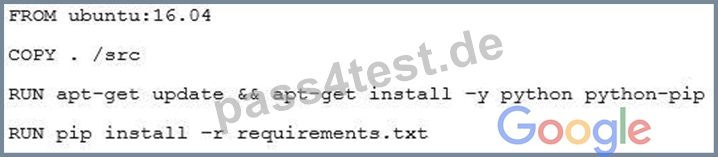
You want to optimize this Dockerfile for faster deployment times without adversely affecting the app's functionality.
Which two actions should you take? Choose 2 answers.
- A. Use a slimmed-down base image like Alpine linux.
- B. Copy the source after the package dependencies (Python and pip) are installed.
- C. Use larger machine types for your Google Container Engine node pools.
- D. Remove Python after running pip.
- E. Remove dependencies from requirements.txt.
Antwort: A,B
Begründung:
The speed of deployment can be changed by limiting the size of the uploaded app, limiting the complexity of the build necessary in the Dockerfile, if present, and by ensuring a fast and reliable internet connection.
Note: Alpine Linux is built around musl libc and busybox. This makes it smaller and more resource efficient than traditional GNU/Linux distributions. A container requires no more than 8 MB and a minimal installation to disk requires around 130 MB of storage. Not only do you get a fully-fledged Linux environment but a large selection of packages from the repository.
References: https://groups.google.com/forum/#!topic/google-appengine/hZMEkmmObDU
https://www.alpinelinux.org/about/
127. Frage
You need to evaluate your team readiness for a new GCP project. You must perform the evaluation and create a skills gap plan incorporates the business goal of cost optimization. Your team has deployed two GCP projects successfully to date. What should you do?
- A. Allocate budget to hire skilled external consultants. Create a roadmap for your team to achieve Google Cloud certification based on job role.
- B. Allocate budget to hire skilled external consultants. Set a deadline for the new GCP project.
- C. Allocate budget for team training. Set a deadline for the new GCP project.
- D. Allocate budget for team training. Create a roadmap for your team to achieve Google Cloud certification based on job role.
Antwort: D
Begründung:
Explanation
https://services.google.com/fh/files/misc/cloud_center_of_excellence.pdf
128. Frage
Your company has a Google Workspace account and Google Cloud Organization Some developers in the company have created Google Cloud projects outside of the Google Cloud Organization You want to create an Organization structure that allows developers to create projects, but prevents them from modifying production projects You want to manage policies for all projects centrally and be able to set more restrictive policies for production projects You want to minimize disruption to users and developers when business needs change in the future You want to follow Google-recommended practices How should you design the Organization structure?
- A. 1 Create folders under the Organization resource named "Development" and Production'
2 Grant all developers the Project Creator IAM role on the ""Development1 folder 3. Move the developer projects into the "Development" folder
4 Set the policies for all projects on the Organization
5 Additionally set the production policies on the "Production" folder - B. 1 Designate the Organization for production projects only
2 Ensure that developers do not have the Project Creator IAM role on the Organization
3 Create development projects outside of the Organization using the developer Google Workspace accounts
4 Set the policies for all projects on the Organization
5 Additionally set the production policies on the individual production projects - C. 1 Create a second Google Workspace account and Organization
2 Grant all developers the Project Creator IAM role on the new Organization
3 Move the developer projects into the new Organization
4 Set the policies for all projects on both Organizations.
5 Additionally set the production policies on the original Organization - D. 1 Create a folder under the Organization resource named "Production '
2 Grant all developers the Project Creator IAM role on the Organization 3. Move the developer projects into the Organization
4 Set the policies for all projects on the Organization
5 Additionally set the production policies on the 'Production" folder
Antwort: A
Begründung:
Explanation
This option can help create an organization structure that allows developers to create projects, but prevents them from modifying production projects. Folders are containers for projects and other folders within Google Cloud organizations. Folders allow resources to be structured hierarchically and inherit policies from their parent resources. By creating folders under the organization resource named "Development" and
"Production", you can organize your projects by environment and apply different policies to them. By granting all developers the Project Creator IAM role on the "Development" folder, you can allow them to create projects under that folder, but not under the "Production" folder. By moving the developer projects into the
"Development" folder, you can ensure that they are subject to the policies set on that folder. By setting the policies for all projects on the organization, you can manage policies centrally and efficiently. By additionally setting the production policies on the "Production" folder, you can enforce more restrictive policies for production projects and prevent developers from modifying them. The other options are not optimal for this scenario, because they either create a second Google Workspace account and organization, which increases complexity and cost (A), or do not use folders to organize projects by environment, which makes it harder to manage policies and permissions (B, D). References:
https://cloud.google.com/resource-manager/docs/creating-managing-folders
https://cloud.google.com/architecture/framework/system-design
129. Frage
Your company has just recently activated Cloud Identity to manage users. The Google Cloud Organization has been configured as wed. The security learn needs to secure protects that will be part of the Organization. They want to prohibit IAM users outside the domain from gaining permissions from now on. What should they do?
- A. Configure Cloud Scheduler o trigger a Cloud Function every hour that removes all users that don't belong to the Cloud identity domain from all projects.
- B. Create a technical user (e g . crawler@yourdomain com), and give it the protect owner rote at root organization level Write a bash script that
* Lists all me IAM rules of all projects within the organization
* Deletes all users that do not belong to the company domainCreate a Compute Engine instance m a project within the Organization and configure gcloud to be executed with technical user credentials Configure a cron job that executes the bash script every hour. - C. Configure an organization policy to restrict identities by domain
- D. Configure an organization policy to block creation of service accounts
Antwort: C
Begründung:
Explanation
https://cloud.google.com/resource-manager/docs/organization-policy/restricting-domains
130. Frage
Case Study: 3 - JencoMart Case Study
Company Overview
JencoMart is a global retailer with over 10,000 stores in 16 countries. The stores carry a range of goods, such as groceries, tires, and jewelry. One of the company's core values is excellent customer service. In addition, they recently introduced an environmental policy to reduce their carbon output by 50% over the next 5 years.
Company Background
JencoMart started as a general store in 1931, and has grown into one of the world's leading brands known for great value and customer service. Over time, the company transitioned from only physical stores to a stores and online hybrid model, with 25% of sales online. Currently, JencoMart has little presence in Asia, but considers that market key for future growth.
Solution Concept
JencoMart wants to migrate several critical applications to the cloud but has not completed a technical review to determine their suitability for the cloud and the engineering required for migration. They currently host all of these applications on infrastructure that is at its end of life and is no longer supported.
Existing Technical Environment
JencoMart hosts all of its applications in 4 data centers: 3 in North American and 1 in Europe, most applications are dual-homed.
JencoMart understands the dependencies and resource usage metrics of their on-premises architecture.
Application Customer loyalty portal
LAMP (Linux, Apache, MySQL and PHP) application served from the two JencoMart-owned U.S.
data centers.
Database
* Oracle Database stores user profiles


* PostgreSQL database stores user credentials
-homed in US West


Authenticates all users
Compute
* 30 machines in US West Coast, each machine has:


* 20 machines in US East Coast, each machine has:
-core CPU

RAID 1)
Storage
* Access to shared 100 TB SAN in each location
* Tape backup every week
Business Requirements
* Optimize for capacity during peak periods and value during off-peak periods
* Guarantee service availably and support
* Reduce on-premises footprint and associated financial and environmental impact.
* Move to outsourcing model to avoid large upfront costs associated with infrastructure purchase
* Expand services into Asia.
Technical Requirements
* Assess key application for cloud suitability.
* Modify application for the cloud.
* Move applications to a new infrastructure.
* Leverage managed services wherever feasible
* Sunset 20% of capacity in existing data centers
* Decrease latency in Asia
CEO Statement
JencoMart will continue to develop personal relationships with our customers as more people access the web. The future of our retail business is in the global market and the connection between online and in-store experiences. As a large global company, we also have a responsibility to the environment through 'green' initiatives and polices.
CTO Statement
The challenges of operating data centers prevents focus on key technologies critical to our long- term success. Migrating our data services to a public cloud infrastructure will allow us to focus on big data and machine learning to improve our service customers.
CFO Statement
Since its founding JencoMart has invested heavily in our data services infrastructure. However, because of changing market trends, we need to outsource our infrastructure to ensure our long- term success. This model will allow us to respond to increasing customer demand during peak and reduce costs.
For this question, refer to the JencoMart case study.
JencoMart has decided to migrate user profile storage to Google Cloud Datastore and the application servers to Google Compute Engine (GCE). During the migration, the existing infrastructure will need access to Datastore to upload the dat
- A. What service account key-management strategy should you recommend?
- B. Provision service account keys for the on-premises infrastructure and use Google Cloud Platform (GCP) managed keys for the VMs
- C. Deploy a custom authentication service on GCE/Google Container Engine (GKE) for the on- premises infrastructure and use GCP managed keys for the VMs.
- D. Authenticate the on-premises infrastructure with a user account and provision service account keys for the VMs.
- E. Provision service account keys for the on-premises infrastructure and for the GCE virtual machines (VMs).
Antwort: D
Begründung:
Migrating data to Google Cloud Platform
Let's say that you have some data processing that happens on another cloud provider and you want to transfer the processed data to Google Cloud Platform. You can use a service account from the virtual machines on the external cloud to push the data to Google Cloud Platform. To do this, you must create and download a service account key when you create the service account and then use that key from the external process to call the Cloud Platform APIs.
References:
https://cloud.google.com/iam/docs/understanding-service-
accounts#migrating_data_to_google_cloud_platform
131. Frage
......
Professional-Cloud-Architect Fragen Beantworten: https://www.pass4test.de/Professional-Cloud-Architect.html
- Professional-Cloud-Architect Zertifikatsfragen ???? Professional-Cloud-Architect Examsfragen ???? Professional-Cloud-Architect German ???? Suchen Sie auf ( de.fast2test.com ) nach kostenlosem Download von ▶ Professional-Cloud-Architect ◀ ????Professional-Cloud-Architect Lernhilfe
- Professional-Cloud-Architect Google Certified Professional - Cloud Architect (GCP) Pass4sure Zertifizierung - Google Certified Professional - Cloud Architect (GCP) zuverlässige Prüfung Übung ???? Geben Sie “ www.itzert.com ” ein und suchen Sie nach kostenloser Download von { Professional-Cloud-Architect } ????Professional-Cloud-Architect Originale Fragen
- Google Professional-Cloud-Architect Quiz - Professional-Cloud-Architect Studienanleitung - Professional-Cloud-Architect Trainingsmaterialien ???? Öffnen Sie die Website ☀ www.it-pruefung.com ️☀️ Suchen Sie ➤ Professional-Cloud-Architect ⮘ Kostenloser Download ????Professional-Cloud-Architect Dumps Deutsch
- Professional-Cloud-Architect: Google Certified Professional - Cloud Architect (GCP) Dumps - PassGuide Professional-Cloud-Architect Examen ???? Suchen Sie jetzt auf ➤ www.itzert.com ⮘ nach 「 Professional-Cloud-Architect 」 um den kostenlosen Download zu erhalten ⭐Professional-Cloud-Architect Zertifikatsfragen
- Professional-Cloud-Architect Prüfung ???? Professional-Cloud-Architect Prüfungsfrage ???? Professional-Cloud-Architect Zertifizierungsprüfung ???? Öffnen Sie die Webseite ▷ www.echtefrage.top ◁ und suchen Sie nach kostenloser Download von ▛ Professional-Cloud-Architect ▟ ⛵Professional-Cloud-Architect Lernhilfe
- Die seit kurzem aktuellsten Google Professional-Cloud-Architect Prüfungsunterlagen, 100% Garantie für Ihen Erfolg in der Google Certified Professional - Cloud Architect (GCP) Prüfungen! ???? Sie müssen nur zu ▷ www.itzert.com ◁ gehen um nach kostenloser Download von ▛ Professional-Cloud-Architect ▟ zu suchen ????Professional-Cloud-Architect Deutsch
- Echte und neueste Professional-Cloud-Architect Fragen und Antworten der Google Professional-Cloud-Architect Zertifizierungsprüfung ???? Suchen Sie auf der Webseite ➠ www.deutschpruefung.com ???? nach “ Professional-Cloud-Architect ” und laden Sie es kostenlos herunter ✋Professional-Cloud-Architect Examsfragen
- Professional-Cloud-Architect Schulungsangebot - Professional-Cloud-Architect Simulationsfragen - Professional-Cloud-Architect kostenlos downloden ???? Suchen Sie auf ⮆ www.itzert.com ⮄ nach ✔ Professional-Cloud-Architect ️✔️ und erhalten Sie den kostenlosen Download mühelos ????Professional-Cloud-Architect Examsfragen
- Professional-Cloud-Architect Exam Fragen ???? Professional-Cloud-Architect Deutsch ???? Professional-Cloud-Architect Zertifizierung ???? Suchen Sie jetzt auf { www.zertfragen.com } nach “ Professional-Cloud-Architect ” um den kostenlosen Download zu erhalten ????Professional-Cloud-Architect Übungsmaterialien
- Wir machen Professional-Cloud-Architect leichter zu bestehen! ???? Suchen Sie auf der Webseite ➡ www.itzert.com ️⬅️ nach ( Professional-Cloud-Architect ) und laden Sie es kostenlos herunter ⛹Professional-Cloud-Architect Exam Fragen
- Google Professional-Cloud-Architect Quiz - Professional-Cloud-Architect Studienanleitung - Professional-Cloud-Architect Trainingsmaterialien ➡️ Suchen Sie einfach auf { de.fast2test.com } nach kostenloser Download von ▷ Professional-Cloud-Architect ◁ ????Professional-Cloud-Architect Lernhilfe
- bookmarkusers.com, arunpqrn602803.get-blogging.com, deborahvemk830083.nico-wiki.com, alyssawmsm984829.p2blogs.com, icelisting.com, susantmmc268564.governor-wiki.com, kallumpahf957137.blogunteer.com, jakubmrei990696.wikiannouncing.com, listfav.com, shaunafjcm645130.elbloglibre.com, Disposable vapes
P.S. Kostenlose 2026 Google Professional-Cloud-Architect Prüfungsfragen sind auf Google Drive freigegeben von Pass4Test verfügbar: https://drive.google.com/open?id=12eyW-5I356xLiT2VQ9SdlgSK1mab_yw6
Report this wiki page